Property management: the Maintenance Desk
Can AI triage every maintenance request?
Usually, yes. A request comes in by email, text or portal; the desk reads it, checks the lease and the unit's history, picks the vendor from your own list and drafts the work order. Your coordinator approves and sends it.
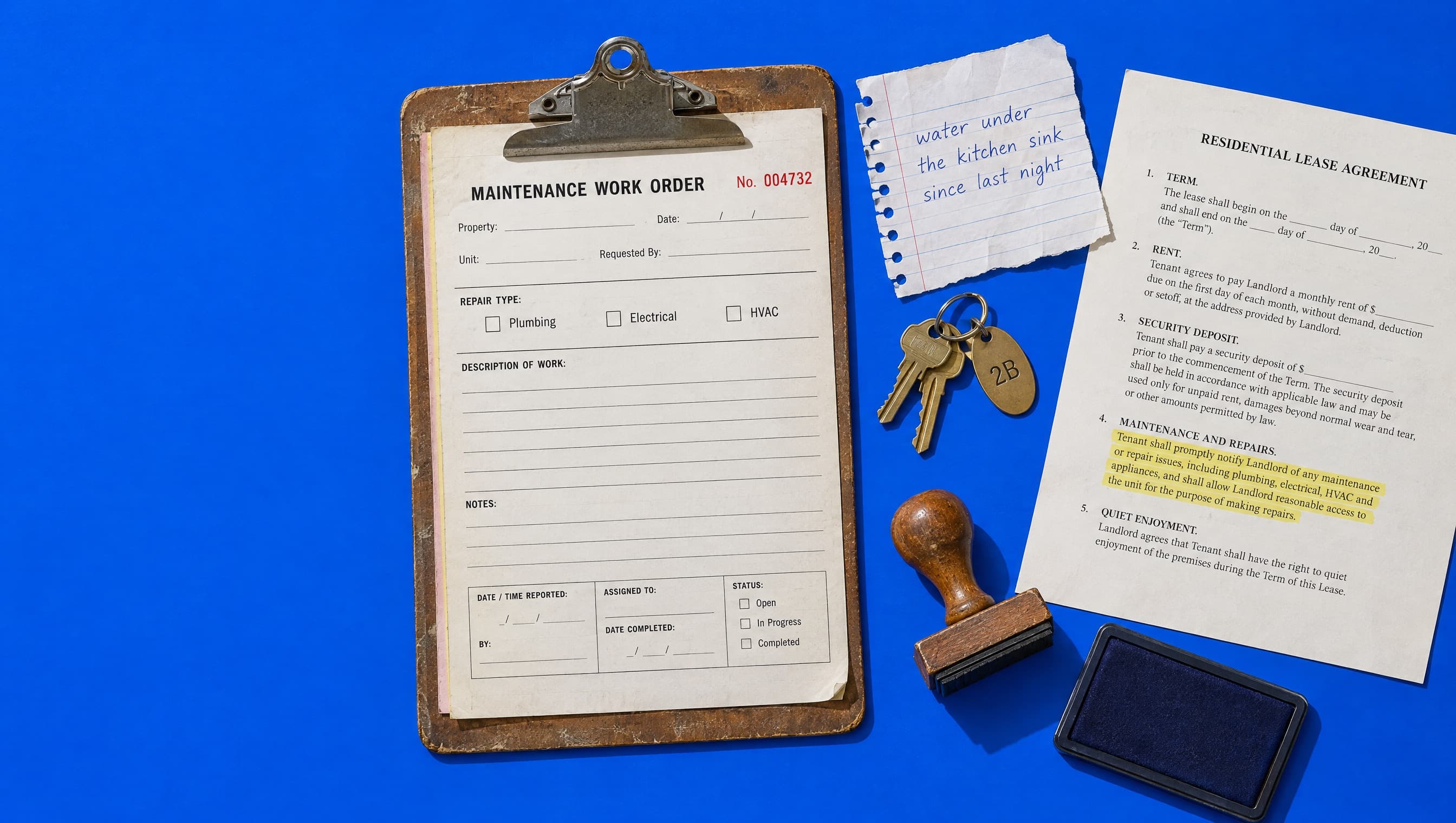
- Tenant portal"Water under the kitchen sink since last night", unit 2B
- PhotoIMG_4471.jpg, the cabinet floor
- Lease file2B lease, maintenance clause
- Vendor listPlumbers you use for this building
- Read the request and the photo0:04
- Checked the lease: landlord's repair0:06
- Found two prior plumbing calls on 2B0:05
- Set urgency from your rules: same day0:03
- Picked the plumber from your list0:06
- Drafted the work order with access notes0:38
One request, start to finish.
The sample request above, step by step. Each step is a setting in your rulebook, not a rebuild.
The Maintenance Desk, one request, as it ran
Sample request. Sample building, sample tenant.- Request
- MR-1187, plumbing
- Unit
- 2B, sample building, Orlando, FL
- Received
- Today, 9:02 pm, tenant portal
| Document | Source | Status | Time |
|---|---|---|---|
| Tenant's message"Water under the kitchen sink since last night" | Tenant portal, unit 2B | Read | 0:04 |
| Lease and unit history | The firm's own records: two prior plumbing calls | Read | 0:11 |
| Urgency and category | The firm's rulebook: active leak, same day | Read | 0:03 |
| Vendor | Your vendor list: the plumber you use for this building | Collected | 0:06 |
| Work orderDrafted with photos, access notes and the not-to-exceed amount | Your work order template | Waiting on the coordinator | 0:38 |
A request comes in. The desk reads it, however it arrived.
Portal, email, text or a voicemail transcript. It pulls out the unit, the problem and the photos.
It checks the lease and the unit's history.
Who pays for what, what has been fixed before, which vendor did it, and whether this is the third time.
It sets the urgency from your rules.
An active leak is same day; a dripping tap is this week. Your thresholds, written once, applied every time.
The work order arrives as a finished draft.
The vendor from your list, the access notes, the photos, the not-to-exceed amount, in the template you already send.
Your coordinator approves, changes or sends.
Nothing goes to a vendor or a tenant until a person says so. The desk logs the decision and learns from it.
Where it stops.
The desk prepares. These stay with a person, every time.
Hire vs. build.
The plain comparison. Your own numbers go in on the call.
The next maintenance coordinator
- Every year, for as long as they stay
- Four to eight weeks to learn the buildings and the vendors
- Out sick when the pipes freeze
The Maintenance Desk
- One-time setup that covers configuring it to your buildings, vendors and rules
- A fixed monthly fee, about a quarter of what the work costs you now
- Your data and rules, exportable any day
Wage: US median for secretaries and administrative assistants, Bureau of Labor Statistics, Occupational Employment and Wage Statistics, May 2025.
The review.
We start by watching a request come in, not by pitching. Free, 60 to 90 minutes, in your office or on a screen share.
Show us how a request comes in today.
The portal, the inbox, the vendor list, the work order you send.
Get a proposal in your own numbers.
What triage costs you now, the desk that takes it over, and the monthly fee.
Decide.
The review is free. The proposal is good for 14 days.
Proof, the honest version
The request above is a sample, and says so. Named clients and measured hours appear here when owners say yes, and not before.